How to Avoid Freight Forwarder Sourcing Risks: A Step-by-Step Guide for Small Wholesalers

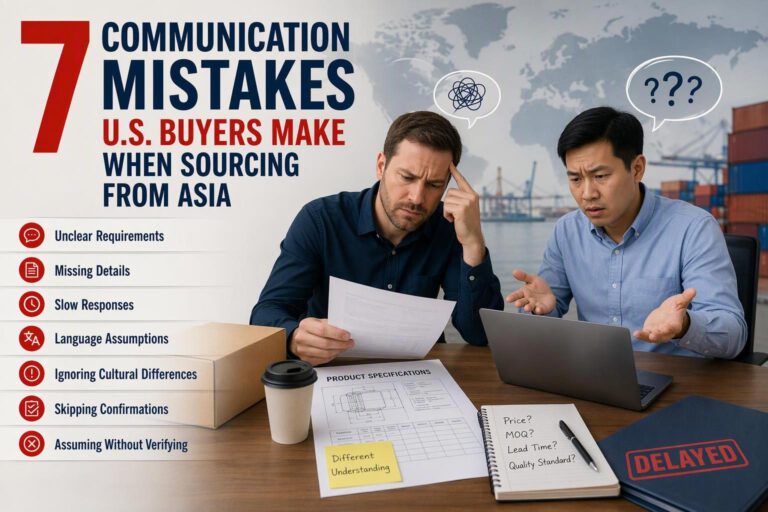
You already have a forwarder who “handles sourcing.” That arrangement is where most freight forwarder sourcing risks begin, because a freight relationship was never built to carry sourcing responsibility. The bundled quote looks complete, no inspection record exists, and the carrier’s liability window closes long before a defect surfaces at your customer’s dock. When that happens, the loss lands on you: rework, refunds, and a supplier who was paid months ago.
Key Takeaways
The importer of record is legally responsible for the customs declaration, regardless of who prepared the paperwork.
A bundled quote hides four cost layers: goods, freight, duties and fees, and the margin on each.
Carrier liability is capped, and the shipper carries the burden of proof when cargo is lost or damaged.
A pre-shipment inspection report is the only artifact that moves defect risk back to the supplier before goods ship.
Why Freight Forwarder Sourcing Risks Hit Small Wholesalers Hardest
The exposure is structural, not a matter of picking the wrong vendor. Low volume buys no rate leverage, no dedicated account manager, and no in-house compliance staff, so every opaque line item lands on the owner’s desk.
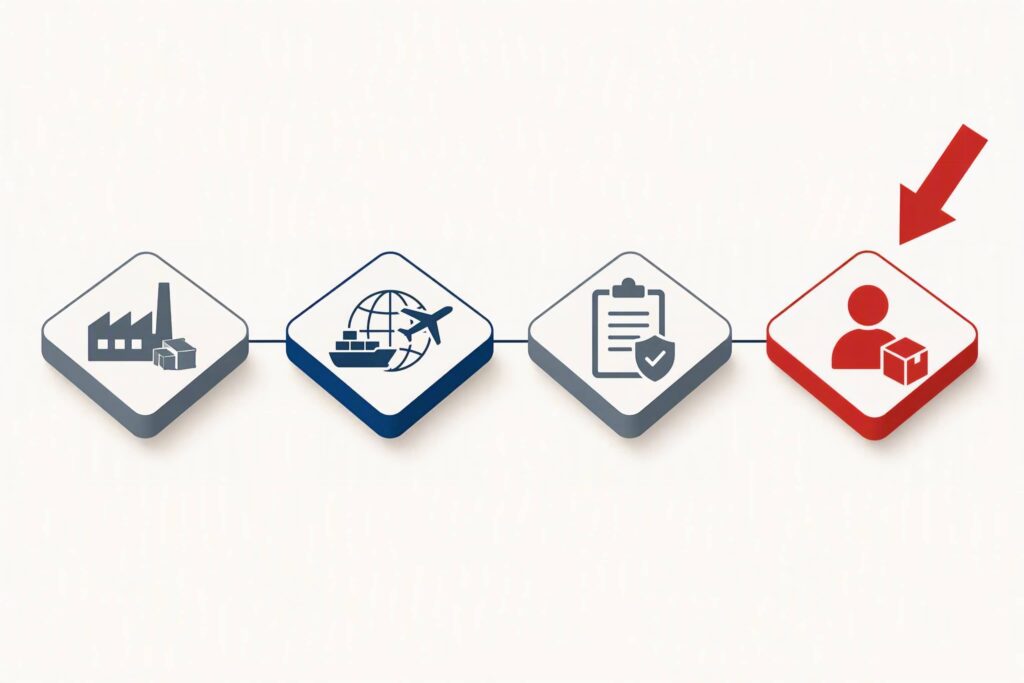
That asymmetry matters more now than it did a few years ago. A sourcing partner for small wholesalers can book the freight, file the entry, and arrange the inspection, but none of that transfers the legal position. Under U.S. customs rules, the importer of record is the party named as importer on the customs declaration and is legally responsible for every piece of data on it, independent of who owns or receives the goods. A broker filing under direct representation is not legally responsible for the declaration’s accuracy; the importer of record remains responsible. That is also why the importer of record carries the tariff liability: CBP requires that party to pay applicable duties, taxes, tariffs and fees and to use reasonable care in ascertaining every element needed to pay the correct amount.
Key Takeaway: Before evaluating any forwarder or sourcing arrangement, answer one question: who is legally the importer of record on your shipments? Whoever holds that position absorbs the compliance, duty, and accuracy consequences, regardless of who booked the freight.
What Blind Freight Forwarder Sourcing Actually Costs You
The cost of blind freight forwarder sourcing is not the freight rate. It is the four things a bundled quote hides: product cost, handling, coordination, and duty. Total landed cost transparency means seeing each of those lines separately, and hidden freight markups survive only because they stay inside one number.
The line items you should be able to read apart are FOB product cost, ocean freight and origin charges, insurance, customs duty, Section 301 where the HTS subheading triggers it, Merchandise Processing Fee, Harbor Maintenance Fee, brokerage and entry fees, drayage, and a demurrage contingency. The Harbor Maintenance Fee is 0.125 percent of cargo value with no cap or minimum stated in the regulation (19 CFR 24.24). Demurrage, when a container sits past its free time, runs roughly $75 to $300 per container per day (Freightos, updated 2026-06-28). That contingency matters more than it used to: CBP’s suspension of the $800 de minimis exemption means entries valued at $800 or less now require formal or informal entry procedures (Federal Register, 2026-06-24).
One caveat on the fee list: the Merchandise Processing Fee ad valorem rate is listed here but was not verified in this run, so check the current rate per entry before you build it into a margin calculation.
The Four Failure Modes of Treating a Forwarder as a Sourcing Partner
Opaque pricing
A bundled quote is the mechanism that makes every other risk unpriceable, because you cannot see which cost moved when the total changes. Ask for the quote broken into unit price, tooling or setup, inland pickup at origin, export clearance, ocean or air freight, destination charges, duty, and the partner’s own fee. The tell that a quote cannot be decomposed is a single landed figure with no per-unit basis and no stated incoterm. If the partner cannot tell you what the goods cost before freight, you are not buying a product, you are buying a number.
Cargo loss and the liability ceiling
The cap, not the loss, is your real exposure. Ocean carrier liability for lost or damaged cargo is capped at $500 USD per package, or per customary freight unit where goods are not shipped in packages, unless one of COGSA’s eight enumerated defenses applies, and the per-mode limits differ sharply: 2 SDR/kg by ocean, 8.33 SDR/kg by road, 17 SDR/kg by rail, and 22 SDR/kg by air, as set out in a comparative survey of cargo liability limits. Even that cap is conditional. Under how COGSA’s per-package cap and fair-opportunity rule work, the carrier can limit liability to $500 per package only if it gave you a fair opportunity to declare a higher value and pay more for it, and the 9th Circuit requires an actual blank space in the bill of lading for that declaration.
Insurance is a separate layer. The difference between cargo insurance and carrier legal liability is that insurance transfers accidental financial loss to an insurer, while carrier liability is the transport company’s legal responsibility for goods in its care, custody and control. And why the shipper carries the burden of proof matters here: you must prove the carrier’s negligence caused a direct loss and that it failed to exercise due diligence, and the ceilings often fall short of full value.
Pro Tip: The fair-opportunity rule is the one clause to look for in the bill of lading. If there is no blank space to declare a higher value, you may have already accepted the $500 ceiling.
No pre-shipment inspection
A supplier’s own QC report is a self-assessment, not evidence. A pre-shipment inspection is a third-party draw against a defined plan, and how an AQL 2.5 inspection plan is actually set explains why the number is widely misread: AQL 2.5 is a sampling decision rule and the customary default for major defects on general merchandise, not a per-lot defect ceiling, because a lot somewhat worse than the AQL can still pass on a given draw. That is consumer’s risk, and it sits with you. The report issued before shipment is the only artifact that moves defect risk back onto the supplier while you still hold leverage.
After-sales accountability
The claims window usually closes long before the defects surface. Goods clear, ship, and land in your warehouse weeks later, and by then the inspection window, the freight claim window, and the supplier’s own return period have all expired on different dates. Ask who owns after-sales accountability in sourcing when a defect appears at your dock: the forwarder, the supplier, or you. If the answer is not written into the agreement with a deadline attached, the answer is you.
How to Separate Sourcing Responsibility from Freight Responsibility
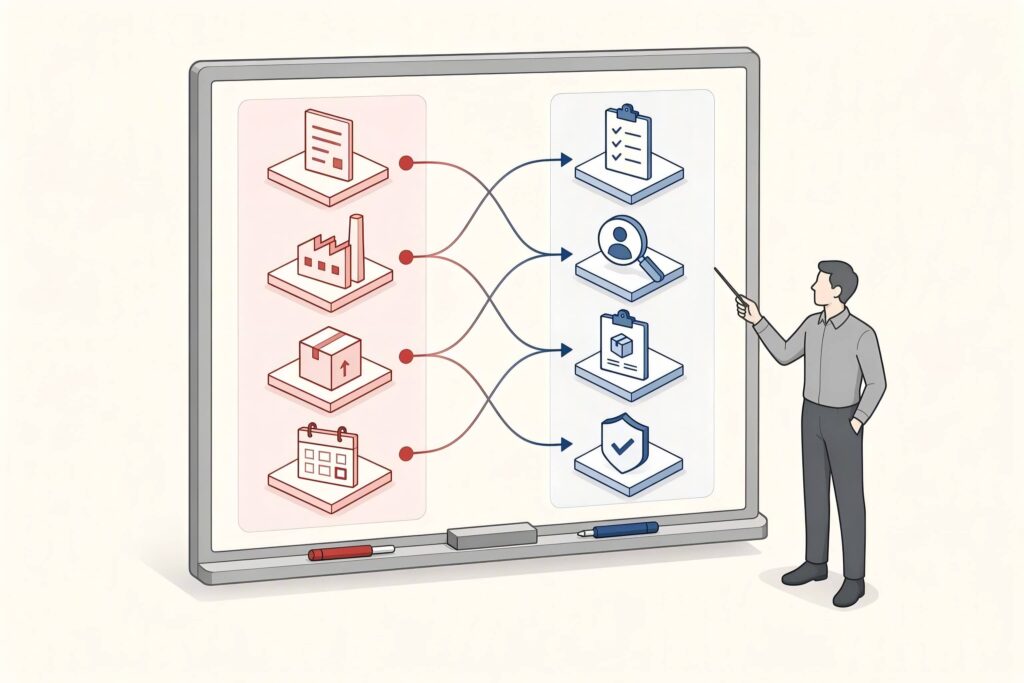
Sourcing and freight are two different jobs with two different accountabilities, and the Incoterm is the line where they divide. The freight forwarder vs sourcing agent distinction matters here: one moves cargo you already own, the other decides what gets bought, from whom, and at what price.
The importer-of-record role sits on that line, and it can be moved. According to Foley & Lardner’s analysis of tariffs and importer-of-record contract terms (2025), CBP permits the owner, purchaser, consignee, or a licensed customs broker or third-party logistics provider acting on their behalf to hold the role, and the parties may allocate it in the contract or through the chosen Incoterm.
Four handoff points decide who answers when something goes wrong:
Handoff point | Sourcing side owns | Freight side owns |
|---|---|---|
Quote construction | Unit price, MOQ, payment terms | Freight, duty, insurance lines |
Supplier verification | Factory identity, capability, capacity | Carrier and routing legitimacy |
Pre-shipment inspection | Booking it, defining the checklist | Scheduling around the loading window |
Claims window | Supplier remedy, replacement, credit | Carrier claim, insurance filing |
Key Takeaway: The one place a contractual allocation will not hold is antidumping duty. Importers must certify to Customs that they have not agreed to reimbursement for it, so no contract clause can shift that cost.
A Standardized Sourcing Sequence You Can Demand From Any Partner
The alternative to blind forwarding is a sequence that produces checkable artifacts, and you can require those artifacts from any partner you choose. Seven stages, five deliverables.
Requirements. You hand over a written requirement sheet: item, specification, quantity, target unit price, packaging, and required delivery window.
Sourcing. The partner returns supplier options with factory names and locations, not a category description.
Quoting. You receive an itemized quote that separates unit price, freight, duties, and service fees, so total landed cost transparency is something you can audit rather than assume.
Verification. The partner supplies a verification record confirming the supplier exists, holds the claimed capability, and can produce the specification.
Sampling. You approve a physical sample in writing before any production run starts.
Follow-Up. The partner reports production status against a schedule you agreed to, not on request.
Shipping. A pre-shipment inspection report reaches you before the goods leave the factory, and the inspection gate is the one you never waive.
A sourcing partner for small wholesalers that runs this sequence, rather than a forwarder that only books space, is what makes each stage checkable. Costlou is one example: a U.S.-based sourcing partner with 30+ years of sourcing experience working on small-batch, multi-category purchasing, including what Costlou sources across categories such as building materials and industrial components. The sequence above is the test, not the brand. Ask any candidate partner to produce these five artifacts on your next order, and the ones who cannot will tell you so before you commit.
Red Flags and Must-Have Criteria Before You Commit
Separate the deal-breakers from the preferences before you negotiate, because price is the easiest term to move and the least likely to protect you. Four terms are must-haves: an itemized quote you can decompose line by line, a named importer of record, a pre-shipment inspection report, and a stated claims window with a deadline you can hold someone to.
The red flags mirror them. A quote that cannot be broken into goods, freight, duty, and fees is not a quote, it is a number. No inspection record offered, no named party accepting declaration responsibility, and after-sales terms that end at delivery all point to the same gap: nobody has accepted the risk you are being asked to carry.
⚠️ Warning: One red flag disqualifies a partner on its own. If a provider will not name who is the importer of record on your shipments, stop. That refusal means the declaration responsibility, and the liability attached to it, is being left with you by default.
Apply this decision rule to your shortlist: a partner that satisfies all four must-haves moves forward, a partner with any single disqualifying red flag comes off the list, and everything else is a preference you can trade on price. For how that sequence looks in practice, see about Costlou’s sourcing practice, which is one example of a sourcing partner for small wholesalers documenting each step rather than bundling it.
What to Do Next
The next action is not to switch vendors. It is to ask your current arrangement for two things and see what comes back: one itemized quote that breaks out product cost, freight, duties, and fees, and one written commitment to a pre-shipment inspection before goods leave the factory.
That single request tells you more than a month of comparison shopping. A partner who can produce both is already operating the way a sourcing partner for small wholesalers should. A partner who deflects either one has answered your question too.
If you want to see the itemized format in practice, Costlou’s quote form supports a request for a full landed-cost breakdown and an inspection commitment on a live order. Costlou’s standardized sourcing process can be used to compare your current terms against a documented one, without committing to a purchase.
FAQ
Is a freight forwarder the same as a sourcing agent?
No. A freight forwarder arranges transport: booking cargo space, preparing documents, moving goods. A sourcing agent identifies suppliers, verifies them, negotiates price, and stays accountable after arrival. The freight forwarder vs sourcing agent distinction matters because a forwarder has no obligation to check whether the factory behind your order can produce it.
Who is legally the importer of record on my shipments?
The party named on the customs declaration, who answers for its accuracy and for paying duties regardless of who owns the goods. Ownership and legal responsibility are separate questions, so a shipment you paid for can still leave you exposed. Confirm the named party on every entry before the cargo moves.
Does cargo insurance replace the carrier's liability?
No. Cargo insurance transfers financial risk to an insurer, not legal responsibility away from the carrier. If you file a claim, the burden of proving what happened to the goods generally falls on you as the shipper.
What does a pre-shipment inspection actually check?
Quantity, workmanship, packaging, labeling, and conformity to your specification before the goods leave the factory. Most inspections sample rather than check every unit, commonly at AQL 2.5, which accepts a defined number of defects within a lot. That rule carries consumer’s risk: a passing result does not certify every unit.
Why can't I tell what a bundled quote includes?
Because it collapses freight, customs brokerage, duties, and handling into one number, you cannot compare it against another supplier’s quote or see which line moved when the total changes. A decomposable quote shows each cost separately, which is what total landed cost transparency requires.
What should I ask a sourcing partner before committing?
Who is named as importer of record, which inspection standard applies and at what AQL, whether quotes are itemized by cost line, and what happens if goods fail inspection after arrival. Get each answer in writing before you place a first order.
Conclusion
The gap between what you think you bought and what you can actually enforce is the whole problem. A forwarder moves cargo; it does not own the purchase decision, the specification, or the supplier relationship behind it.
That gap shows up in four places: opaque pricing, cargo loss against a liability ceiling, no pre-shipment inspection, and after-sales accountability that lands on you rather than on anyone upstream.
Closing it means running a seven-stage sourcing sequence and keeping the artifacts each stage produces, so that when something goes wrong you are holding a record instead of an explanation. Before you commit to any partner, check the must-have criteria and the red flags against what they will actually put in writing.