
How to Source Custom Industrial Components from Asia: A 2026 Step-by-Step Guide

The 2026 tariff and diversification picture has changed what counts as a good supplier. Nearly four in five U.S. import decision-makers, 79%, moved at least some sourcing volume away from China in 2025, and more than 40% plan to diversify further this year, according to the STG Logistics import survey published in March 2026. This guide explains how to source custom industrial components from Asia as a defensible, artifact-by-artifact process, from drawing package to shipment release, with the criteria to compare countries, supplier types, and quotes. It is written for procurement, engineering, and operations leads at U.S. manufacturers. Costlou, a U.S.-based sourcing and quality partner with 30+ years of experience, runs this sequence and visits suppliers, one of several ways to run it.
Key Takeaways
Six stages carry the process: region choice, supplier shortlisting, supplier verification, landed-cost comparison, sample approval, and pre-shipment inspection before balance release.
Duty exposure under the July 24, 2026 tiers is a selection criterion, not an afterthought, so region choice comes before supplier search.
A factory audit and a pre-shipment inspection prove different things: the audit checks the system, the inspection checks the parts in this order.
Quotes are compared on landed cost, not unit price, which means freight, duty, tooling, and inspection costs sit in the same table.
Each stage produces a document you can hold, from the drawing package to the inspection report signed before the balance payment.
How to Source Custom Industrial Components from Asia in 2026: The Short Answer
Sourcing a custom industrial component from Asia in 2026 runs through six stages: build the drawing package, shortlist suppliers, verify the supplier, compare quotes on landed cost, approve the sample, then inspect before releasing the balance payment. Skipping any one of them moves risk downstream, where it costs more to fix.
Key Takeaway: “An audit without a PSI tells you the factory can produce good product, not that they did for your order.”
Prerequisites: What You Need Before the First RFQ
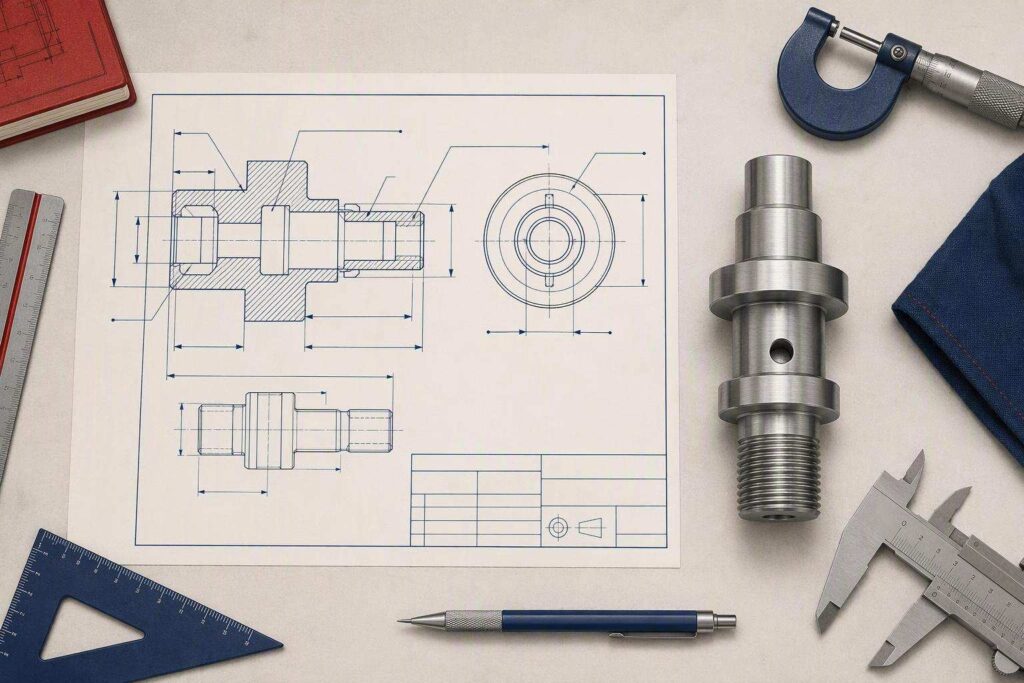
The artifact checklist below is what separates a quote you can compare from a quote you have to renegotiate.
Item | Why you need it | What happens without it |
|---|---|---|
Drawing package with tolerance, material grade, and surface finish callouts | Suppliers quote the same part, not three interpretations of it | Quotes arrive on different assumptions and unit prices are not comparable |
Revision block and dated drawing | You can prove which version was quoted and sampled | Disputes over “that’s not what we approved” have no paper trail |
Sample approval criteria | Defines pass/fail before emotion enters the decision | A marginal sample gets approved because the deadline is close |
Target landed cost | Sets the ceiling the quote must clear | You optimize unit price and lose on freight, duty, and tooling |
Quote line items to request: unit price, tooling, MOQ, lead time, payment terms, inspection cost, freight, duty | Makes every quote answer the same questions | Hidden costs surface after you have committed |
Step 1: Choose the Sourcing Region Against 2026 Duty Exposure
Region choice is now a landed-cost decision, not a geography lesson. Under the Section 301 program rebuilt on July 24, 2026, China sits in the 12.5% band, while India, Bangladesh, Cambodia, Indonesia, Malaysia, Pakistan and Sri Lanka fall in the 10% tier, which Morgan Lewis’s July 2026 client alert describes as covering economies with a forced-labor import ban, a reciprocal-trade commitment, or a partial regime. The same alert notes that for the EU and Taiwan the combined MFN plus Section 301 rate generally does not exceed 10%, and for Japan, Korea and Switzerland it generally does not exceed 12.5%. Articles already subject to Section 232 measures, including covered steel, aluminium, automobiles, automotive parts and copper products, are exempt, so the two regimes do not stack.
That structure changes what a quote comparison means for custom industrial component sourcing in 2026. Two suppliers can quote the same unit price and land at different totals purely because of origin.
Region | 2026 Section 301 tier | Typical component categories | Lead time | Verification difficulty |
|---|---|---|---|---|
China | 12.5% band | Machined parts, castings, assemblies | 30-45 days | Moderate; mature audit market |
India, Bangladesh, Cambodia, Indonesia, Malaysia, Pakistan, Sri Lanka | 10% tier | Machined parts, fasteners, castings, sub-assemblies | 35-55 days | Higher; thinner third-party audit coverage |
EU, Taiwan | Combined MFN + 301 generally ≤10% | Precision components, electronics | 25-40 days | Lower; established quality systems |
Japan, Korea, Switzerland | Combined MFN + 301 generally ≤12.5% | High-precision, specialty alloys | 25-40 days | Lower; established quality systems |
Two cautions before you commit. First, the tier is a starting point, not a final number: your HS classification and the current MFN rate determine the actual duty, and the modified treatment above applies only where MFN duty sits below the ceiling. Second, a lower tier does not automatically mean a lower total. Freight, tooling amortisation and rework risk can erase a 2.5-point duty difference on a small order.
Step 2: Shortlist Suppliers and Tell Factories from Trading Companies
Step 3: Verify the Supplier Before You Send a Drawing
The Decision Point: Stop Buying on Price, Start Qualifying on Process
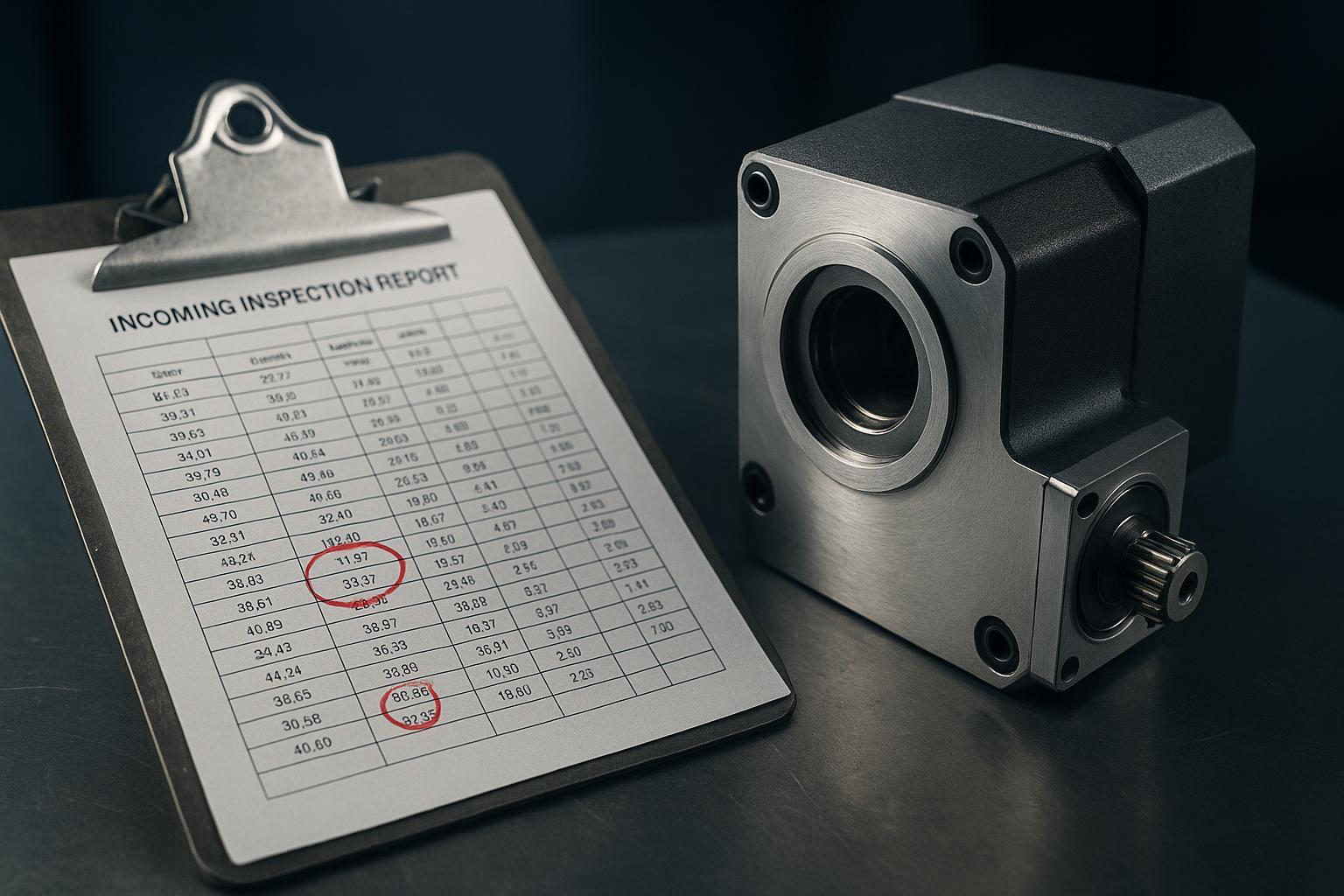
Operations issued one mandate: the next supplier must pass a documented qualification gate before any production order. The rule that made it enforceable was the verification-sample rule: refuse to place a production order with a new supplier without holding a verification sample first (SB5 Supply Solutions). That single condition turned the next supplier search into a process audit rather than a quotation comparison, and it moved the buyer’s first question from unit price to how the supplier would prove the bore stayed in band across every lot.
How the Buyer Built a Qualification Gate Instead of a Vendor List
The buyer replaced vendor list-building with a six-stage qualification gate for industrial component supplier qualification. Every candidate moved through the same sequence: self-assessment, document and certificate review, audit (virtual then on-site), sample evaluation, trial delivery, and production release. supplier qualification framework describes that progression as starting with a 150-question self-assessment covering quality management, capacities and certifications, followed by a two-stage audit and continuous monitoring of critical certificates and licenses. The buyer’s shortlist fell from eleven names to three before a single purchase order existed, and each stage carried its own pass/fail threshold. Clearing one gate did not exempt a supplier from the next.
The Four Criteria That Filtered the List From Eleven to Three
Technical competence and production capacities; quality management system and certifications; financial stability and creditworthiness; and legal compliance and sustainability standards. Evidence decided the score, not assertion. A supplier claiming “broad capacity” ranked below one that produced a machine list, shift pattern and current utilization rate.
The scorecard also forced procurement and engineering onto the same page. Engineering weighted technical competence; procurement weighted financial stability and compliance. Neither side could override the other with opinion alone, which is exactly what a decision matrix is for.
Criterion | Supplier A | Supplier B | Supplier C |
|---|---|---|---|
Technical competence and production capacities | Strong: in-house gear cutting, documented capacity | Moderate: partial outsourcing | Strong: full in-house |
Quality management system and certifications | ISO9001, IATF 16949 | ISO9001 only | ISO9001, IATF 16949 |
Financial stability and creditworthiness | Verified references, stable | Unverified | Verified references, stable |
Legal compliance and sustainability standards | Documented | Incomplete | Documented |
Step 3: Verify the Supplier Before You Send a Drawing
Supplier verification for U.S. buyers runs on two tracks: document checks you can complete from your desk in one to three days, and an on-site visit of half a day to a full day. A verification provider typically delivers its report within 48 hours of that visit, so the whole engagement from booking to report usually takes five to seven business days (Tetra Inspection supplier verification guide, retrieved 2026-03-19). Treat that timeline as one provider’s process, not an industry average.
Vietnam works differently. Companies register with the Department of Planning and Investment, and the tax code is verifiable on the General Department of Taxation portal. Because subcontracting is common, particularly in garments and footwear, confirm whether you are dealing with the factory itself or a subcontractor, and check foreign ownership limits before you commit.
What a verification report does not prove: documents can be fabricated, and only a physical visit confirms that the factory, equipment, and workforce actually exist. A clean paper trail tells you the entity is registered and the address is plausible, not that the parts will meet your drawing.
Step 4: Compare Factory Quotes on Landed Cost, Not Unit Price
The cheapest unit price is rarely the cheapest order. A quote that looks 12% lower per piece can land above the next offer once tooling, freight, duty and inspection are added, and the gap usually shows up after you have already paid the tooling invoice.
Build a quote matrix and require every supplier to fill the same columns. Unit price alone hides the four lines that decide the order: tooling and non-recurring engineering, minimum order quantity, lead time, and payment terms. Add freight, the 2026 duty line computed from your Step 1 tier rather than assumed, and third-party inspection cost. Then divide total cost by the quantity you actually expect to order, not the MOQ.
Line item | Supplier A | Supplier B | Supplier C |
|---|---|---|---|
Unit price at target volume |
|
|
|
Tooling / NRE (one-time) |
|
|
|
MOQ and price breaks |
|
|
|
Lead time (sample / production) |
|
|
|
Payment terms |
|
|
|
Freight to destination |
|
|
|
Duty at 2026 rate for your tier |
|
|
|
Inspection cost per lot |
|
|
|
Landed cost per unit |
|
|
|
Payment terms are a negotiation line, not a fixed condition. In a 2026 survey of importers by STG Logistics, 31.2% of organizations secured more flexible contract terms in response to tariff volatility. Ask for the same before you sign: staged tooling payment, balance on inspection, or a duty-sharing clause.
Step 5: Approve the Sample and Lock the Specification
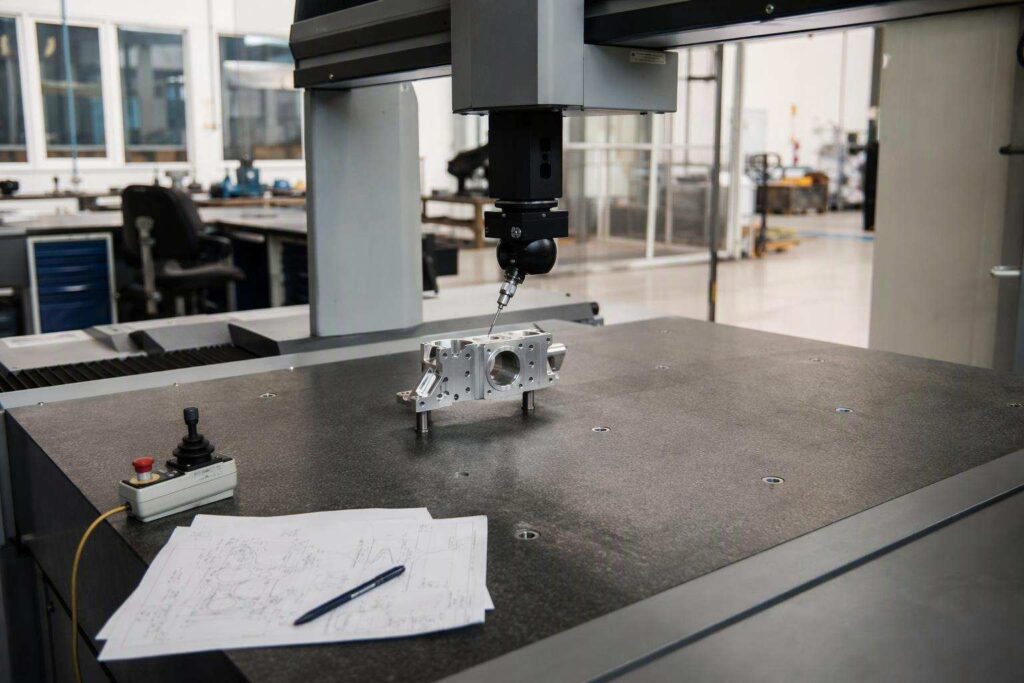
Sample approval is not a courtesy check. The approved sample and the signed drawing revision together become the contractual reference for the order, and the pre-shipment inspection in Step 6 is measured against them. If the drawing revision on the approval form does not match the one on the purchase order, you have approved nothing.
Pro Tip: The pilot run, the first batch made on production machinery with production tooling, may be the source of the part for FAI. Serial production follows once FAI and process verification are complete. Approve the pilot part, not a hand-finished sample.
Step 6: Inspect Before You Release the Balance Payment
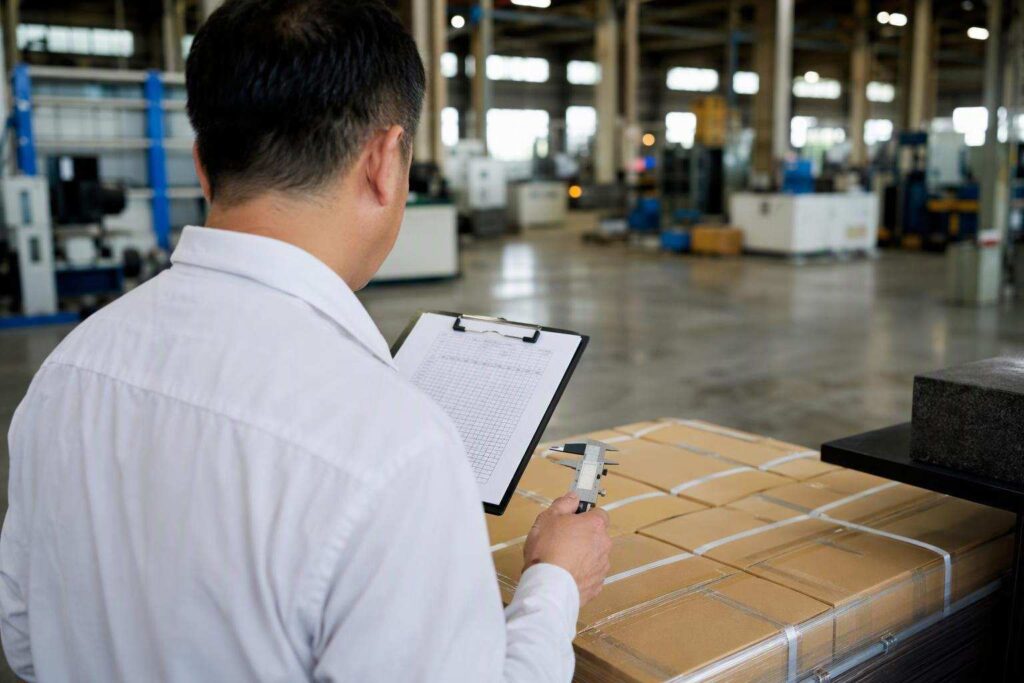
Pre-shipment inspection (PSI) happens at the factory when production is 80–100% complete and at least 80% of the order is packed. An inspector randomly samples units against your specification and AQL thresholds, then issues a pass/fail report before final payment and shipment. That report is the last hard gate you control.
The commercial default for consumer B2B goods is AQL 0 for critical defects, 2.5 for major and 4.0 for minor, at inspection Level II ( retrieved 2026-07-17). At those limits, a sample of 125 units accepts 10 major and 14 minor defects and rejects at 11 and 15. confirms the same defaults and notes a counting rule worth writing into the PO: a defect that qualifies as both major and minor is counted against the stricter limit. Note that AQL 2.5 is a defect threshold, not a sample size.
Defect class | Definition | Example on a machined part | Default AQL |
|---|---|---|---|
Critical | Could harm the user, breach a mandatory regulation, or make goods unsellable | Exposed sharp edge on a load-bearing bracket | 0 |
Major | Would likely cause return or rejection; fails in normal use | Bore outside the drawing tolerance | 2.5 |
Minor | Deviation the end customer would probably keep | Faint scuff on a non-visible face | 4.0 |
Write the protocol into the PO: defect classes, AQL limits, sampling level, and the rule that the balance payment releases only on a passing report.
Reading the Sample Report: Tolerance Data, Material Grade, Surface Finish
When the sample came back, the buyer checked three things against the drawing, not against the supplier’s summary. Dimensional data had to cover every critical callout, the material grade certificate had to match the grade named on the purchase order, and surface finish had to be measured against the drawing note rather than described in words. The buyer worked to a 24 to 72 hour quote turnaround benchmark for a clean RFQ, a common industry benchmark rather than a measured study, and treated a slow or evasive response as a signal in itself.
Specification item | Required evidence | Pass/fail |
|---|---|---|
Critical dimensions and datums | Dimensional report covering every callout |
|
Material grade | Mill or material certificate matched to the PO |
|
Surface finish | Measured value against the drawing note |
|
Conformance | Certificate of conformance signed by the supplier |
|
First-article review | FAI-style report on the submitted sample |
|
Restricted substances | RoHS or REACH support where the part requires it |
|
Common Mistakes to Avoid
Most sourcing failures trace back to five decisions, and each one is cheap to get right and expensive to get wrong.
Treating a factory audit as product verification. An audit examines the process, not the parts you ordered. A supplier can pass a clean audit and still ship a batch that misses your tolerance. Fix: keep the two activities separate and budget for both, because a factory audit and pre-shipment inspection answer different questions about the same supplier.
Comparing unit price instead of landed cost. Unit price hides freight, duty, tooling, and the cost of a rejected batch. Fix: build one landed-cost sheet per supplier before you rank anyone.
Skipping the drawing revision lock at sample approval. If the approved sample and the production drawing drift apart, the factory builds to whichever it read last. Fix: attach the exact revision number to the approval and freeze it.
Accepting a QMS audit as ISO 9001 certification. A quality-management-system audit, checked against ISO 9001:2015 criteria, is a review of how a factory runs its quality process. It is not a certification, and only an accredited certification body can issue one (Asia Quality Focus, retrieved 2026-07-17).
Key Takeaway: A passed QMS audit tells you the process exists. It does not tell you the factory holds a valid ISO 9001 certificate. Ask for the certificate, the issuing body, and the expiry date.
Assuming the 2026 duty tier. Duty exposure changes with the classification you declare, so a rate you remember from last year is a guess. Fix: compute the tier for your specific part before you compare quotes.
What Success Looks Like, and How to Keep It
A sourcing program is working when four artifacts line up: an approved sample tied to a signed drawing revision, an inspection report that matches that sample, a landed cost you can defend line by line, and a supplier file complete enough to run the next order without starting over.
Track four metrics to know whether it holds. First-pass FAI rate tells you how often a supplier gets the drawing right on the first submission, before you spend time on corrections. Inspection pass rate against your agreed AQL shows whether the production run matched the approved sample. Quote-to-PO variance catches the gap between what a factory quoted and what you actually paid once freight, duty, and tooling landed. On-time shipment measures whether the supplier’s schedule discipline survives contact with a real order.
None of these have published industry benchmarks you can cite as a target. Set your own baseline from your first three orders and treat improvement against that baseline as the standard.
The stretch goal is extending the same artifact chain, drawing revision, approved sample, inspection report, to a second source in a different duty tier. A qualified backup supplier in a different tariff band turns a single-source risk into a routing decision.
If you want a second set of eyes on the process, Costlou supports U.S. buyers through the sourcing, quoting, verification, sampling, and shipping sequence and can be used to review a quote or supplier file before you commit.
FAQ
How long does it take to source a custom industrial component from Asia, first RFQ to delivery?
Plan on roughly three to five months for a first-order custom part, and treat that as a range rather than a promise. Tooling and sample rounds consume most of it, and a failed sample restarts the clock. Freight adds two to five weeks depending on mode.
Do I need both a factory audit and a pre-shipment inspection?
Yes, because they answer different questions. An audit asks whether the supplier can make your part consistently; an inspection asks whether this shipment matches the approved sample. A supplier with a clean audit can still ship a bad lot, and a good lot can come out of a shop with no documented process control.
How do I verify a supplier is a real factory and not a trading company?
Ask for the business license, then check that its registered scope covers manufacturing the process you need, not just “machinery sales.” Cross-check the address against satellite imagery and confirm the equipment list matches your drawing. Trading companies are not automatically worse, but you should know which one you are buying from.
What AQL should I specify for custom industrial components?
For most parts, start at AQL 1.0 for major defects and 2.5 for minor ones under ISO 2859-1, then tighten the major level for anything safety-related. AQL sampling assumes a homogeneous lot, so it fits cosmetic and dimensional checks well but not functional or life testing. If a defect would stop your assembly line, specify zero acceptance on that characteristic and test it separately.
How do the 2026 Section 301 tariffs change which country I should source from?
They change the arithmetic, not automatically the answer. Tariff exposure varies by product classification and country of origin, and it stacks on top of freight and lead time, so the country with the lowest unit price is often not the lowest landed cost.
What should a factory quote include so I can compare it fairly?
Require unit price at your stated volume, tooling or NRE cost separately, MOQ, lead time from PO to shipment, Incoterm, packaging spec, and the payment schedule. Ask for the material grade and the inspection standard in writing. Without those fields you are comparing a number to a number.
Conclusion
Sourcing custom industrial components from Asia comes down to six stages: choose the region against 2026 duty exposure, shortlist suppliers and separate factories from trading companies, verify before you send a drawing, compare quotes on landed cost, approve the sample and lock the specification, then inspect before releasing the balance.
Run those stages and you end up with something more useful than a cheaper part. You get a sourcing decision you can defend in three rooms at once: to engineering, because the specification was frozen against an approved sample rather than a drawing revision; to finance, because the landed cost includes duty, freight, and inspection instead of a unit price that quietly grew; and to your customs broker, because the origin, classification, and duty exposure were checked before the purchase order, not after the container arrived.
That is the whole point of the sequence. Each stage exists to remove one category of surprise before money moves, and the cost of running them is small next to the cost of discovering a problem at the port.
If you want a second set of eyes on a live sourcing decision, Costlou runs this same sequence and visits suppliers on the ground.