Custom Industrial Parts Sourcing: The Complete Guide for U.S. Distributors
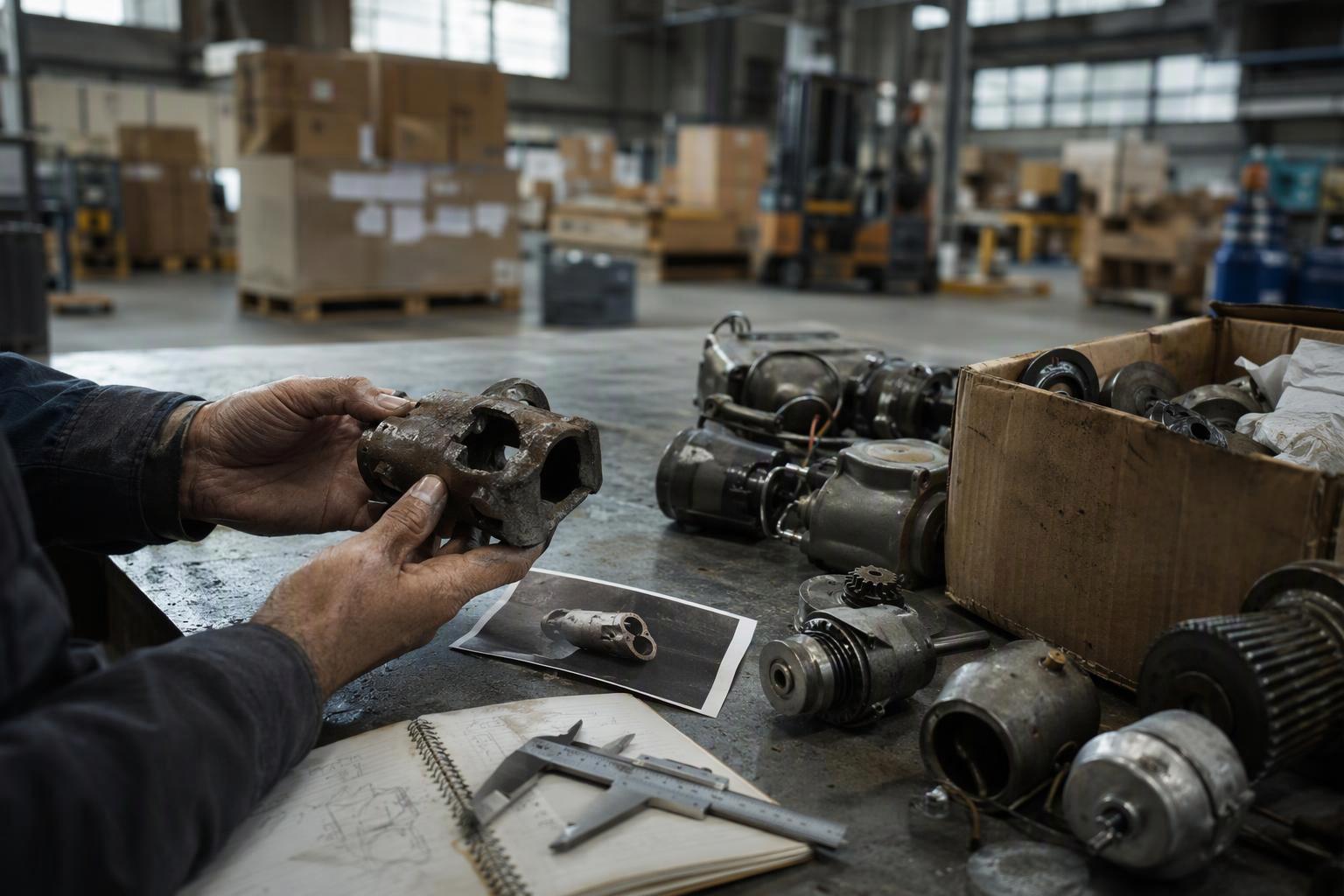
A customer sends a photo of a failed part, a broken sample in a bag, or a paragraph of performance requirements and asks whether you can make it. Nothing in that package is a drawing, and no process has been chosen. The answer is still yes, and this guide shows how custom industrial parts sourcing works when you start from a photo or sample rather than a finished specification package.
You do not need a complete drawing, a decided manufacturing process, or an existing supplier to begin. You need a way to turn what the customer handed you into a requirement that can be quoted, produced and repeated. That is the whole method, and it is what makes custom parts sourcing for U.S. distributors manageable rather than a series of blind guesses.
The 24 customer problems distributors bring to this work fall into six help categories: requirement development, production-path selection, cost control, sampling and production, coordination across factories and languages, and long-term supply under tariff and origin risk. Each category gets its own section below, with the questions to ask and the evidence behind each answer.
This guide was last refreshed in October 2026. Capability statements here are bounded on purpose: design, testing and certification are described as either provided directly or coordinated with named partners, so you can tell which parts of the chain a supplier controls and which it manages through others.
Key Takeaways
A photo, a sample or a written requirement is enough to start; the drawing is an output of the process, not a prerequisite.
Six help categories cover all 24 customer problems, from requirement development through long-term supply.
Sample-to-batch consistency rests on a controlled production baseline and written change notification, not on the sample itself.
Ask every supplier to separate what it provides directly from what it coordinates with partners.
What Is Custom Industrial Parts Sourcing and Why Does It Start From What You Have?
Custom industrial parts sourcing is the process of turning a customer’s partial input, such as a photo, a physical sample, a sketch or a written requirement, into a defined, quotable and repeatable part. It starts from what you have because the definition of the part is the first deliverable, not the entry ticket.
The reason a partial input works is that a requirement is a set of decisions, and decisions can be made in sequence. Material, critical dimensions, tolerances, surface finish, mating interfaces and expected life all have to be pinned down, but they can be pinned down with the customer’s help rather than demanded up front. A distributor that waits for a complete drawing waits forever on most non-standard requests.
The scope of this guide runs from requirement development through long-term supply. It does not cover machining theory or the internal engineering of any specific component family. What it does cover is the sequence a distributor actually walks: capture the requirement, choose a production path, control cost, approve a sample, coordinate the chain, and keep the part available.
Why the Six Help Categories Cover All 24 Customer Problems
The six categories cover all 24 customer problems because each problem is a question about one stage of the same sequence, and the sequence has six stages. A problem about a vague drawing belongs to requirement development. A problem about tooling cost belongs to cost control. Nothing in the list falls outside the chain from input to long-term supply.
The mapping below is the evaluation framework for the rest of this guide. Each row names the problems the category absorbs and the section that handles them.
Help category | Customer problems it absorbs | Handled in |
|---|---|---|
Requirement development | No drawing; missing tolerances; unrecorded assumptions; quote iterations | How Does an Incomplete Input Become a Clear, Quotable Requirement? |
Production-path selection | Wrong process for order size; prototype path reused for reorder; MOQ and tooling mismatch | How Do You Choose the Right Production Path for a Non-Standard Part? |
Cost control | Over-specified tolerance; cosmetic secondary operations; sunk tooling; rework | How Do You Keep Development Cost Reasonable and Avoid Unnecessary Customization? |
Sampling and production | Silent substitution between sample and batch; no first-article record; no change notice | How Do Samples and Production Move Forward, and How Is Sample-to-Batch Consistency Guaranteed? |
Coordination | Factory-or-trader doubt; factory audit; test evidence; language and time-zone lag | How Is Cross-Factory and Cross-Language Coordination Handled, and What Is Provided Directly vs. Coordinated? |
Long-term supply | Tariff shifts; origin questions; forced-labor documentation; second-source planning | How Is Long-Term Supply Supported Under Tariff and Origin Risk? |
The categories also match where the market is moving. The 2026 USA Reshoring Survey, which drew 249 respondents split between 118 OEMs and 131 contract manufacturers, found that 60% of contract manufacturers say their customers who import from the China and Taiwan region are at least discussing de-risking, while only 19% say those customers are actively transitioning away (the 2026 U.S. reshoring survey). Conversations about changing a supply base start long before a finished drawing exists, which is exactly when requirement development and coordination matter most.
For a distributor, the practical value of the framework is that it lets you tell a customer which stage their problem sits in. “We can quote this once we confirm three tolerances” is a better answer than “send us a drawing,” and it moves the request forward instead of parking it.
Can You Get a Custom Industrial Part Quoted From Only a Photo, a Sample, or a Requirement?
Yes. A photo, a sample or a written requirement is enough to begin a custom part quote without a drawing, provided the supplier treats the gaps as questions to resolve rather than as reasons to decline. What changes is the amount of confirmation work, not whether a quote is possible.
Each input type supports a different level of confidence, and knowing which is which prevents the most expensive failure in this work: a part made to a guessed specification.
A photo confirms shape, approximate proportions, mounting features and visible wear patterns. It cannot confirm material grade, hardness, tolerance or surface finish. Those have to be asked.
A physical sample confirms far more, because it can be measured, weighed, sectioned and tested. It still cannot confirm what the customer is willing to change, which is often the difference between an affordable part and an expensive one.
A written requirement confirms performance expectations, such as load, speed, life or environmental exposure, but may leave the geometry open.
A sketch or marked-up drawing confirms intent and critical features, and is usually the fastest route to a firm quote.
The limitation to state plainly to your customer is that a quote built on a photo is a quote for an interpretation. The supplier should list what it assumed, so the customer can correct the assumption before tooling is cut. That list is the single most useful document in the early conversation, because it converts an invisible guess into a visible decision.
A sample also carries a risk that a photo does not: the customer may assume the sample is the specification. It usually is not. A worn sample shows what failed, not what is required, and a sample from a discontinued line may contain a component nobody can source again. Measuring the sample and agreeing which characteristics are critical is the step that turns it into a requirement.
How Does an Incomplete Input Become a Clear, Quotable Requirement?
An incomplete input becomes a quotable requirement when every characteristic is recorded as either confirmed or assumed, with a named person responsible for confirming it. The requirement is complete enough to quote when no assumption remains that could change the price, the process or the fit.
The standard that makes this possible is ASME Y14.5-2018 dimensional and geometric tolerancing, which establishes the symbols, rules and definitions that give a drawing a common design language for form, fit, function and interchangeability. Its value to a distributor is not the symbology itself but the discipline: a characteristic either has a stated tolerance or it does not, and there is no third state.
The checklist below is the working tool. Fill one row per characteristic, and do not release a quote until every row that affects price or fit reads “confirmed.”
Characteristic | Why it matters | Confirmed or assumed | Who confirms |
|---|---|---|---|
Critical dimensions and tolerances | Drives process choice and price | Application engineer | |
Material grade and condition | Drives strength, corrosion and cost | Customer or engineer | |
Surface finish and treatment | Drives secondary operations | Engineer | |
Mating interfaces | Drives fit and function | Customer | |
Load, speed or duty cycle | Drives sizing and life | Customer | |
Environmental exposure | Drives material and sealing | Customer | |
Revision and change control | Prevents rework on an old revision | Purchasing | |
Inspection method and acceptance | Prevents disputes at receipt | Quality |
Model-based definition is increasingly part of this picture. ASME Y14.41 for model-based part definition sets the requirements for preparing and revising digital product definition data, and it exists because a part can now be defined by a model rather than a print. If your customer sends a 3D model, ask which standard governs its interpretation, because a model without stated tolerances is as incomplete as a drawing without them.
Two habits close the loop. First, record the revision on every document you send and receive, so a quote cannot be built on a superseded version. Second, write the assumptions into the quote itself. A quote that says “quoted on 316 stainless, 0.05 mm tolerance on the bore, finish as sampled” gives the customer something specific to correct, and it protects both sides if the part later behaves differently than expected.
How Do You Choose the Right Production Path for a Non-Standard Part?
The right production path is the one whose tooling and setup cost is justified by the order size and the expected repeat volume, not the one that produces the first part fastest. Choosing on prototype speed alone is how small-batch distributors end up with tooling they cannot amortize.
Order size changes the answer more than any other variable. A short run may favor a route with low setup and a higher piece price. A recurring annual volume may justify tooling that lowers the piece price, but only if the volume materializes. The matrix below is the decision tool.
Variable | Question to ask | Low volume | High volume |
|---|---|---|---|
Tooling | Who pays, and who owns it? | Avoid dedicated tooling | Tooling justified by volume |
Setup cost | How much is one-time? | Keep setup minimal | Amortize across the run |
Piece price | What does the curve look like? | Accept higher unit cost | Negotiate on volume |
Material | Is a standard grade acceptable? | Standard stock | Consider custom grade |
Process | Does the process need hard tooling? | Flexible process | Dedicated process |
Change risk | How likely is a design change? | Keep the path flexible | Lock the design first |
The direction of the market supports planning for repeat volume rather than one-off jobs. A 2025 survey found about 30% of U.S. OEMs had reshored or were actively reshoring and another 16% were considering it, and the share that had reshored or were actively reshoring rose to 36% in 2026, as reported in the FCC’s regulatory analysis citing the Reshoring Initiative’s 2025 and 2026 surveys. More domestic and near-shore volume means more reorders, and a production path chosen for a single prototype often cannot carry a reorder.
A neutral example shows how the variables interact. Take a motor requirement described only by size, voltage and duty cycle. The material and process route depends on whether the housing is stamped or machined, which depends on annual volume, and the winding and magnet choices depend on the performance the customer actually needs rather than the sample’s construction. The same requirement can lead to two different production paths with very different cost structures, and the choice belongs to the customer once the trade-offs are visible.
How Do You Keep Development Cost Reasonable and Avoid Unnecessary Customization?
Development cost stays reasonable when you separate one-time costs from recurring costs and challenge every one-time item against the function it serves. Most avoidable cost sits in customization that adds precision or finish the application never needed.
No reliable public figure splits development cost between tooling, engineering and samples, so treat any percentage you are offered with suspicion and work from the structure instead. The worksheet below is the one to fill in with the customer.
Cost item | One-time or recurring | Question that removes cost without removing function |
|---|---|---|
Tooling and fixtures | One-time | Can a standard tool or a flexible process do the job? |
Engineering and drafting | One-time | Which tolerances are truly critical to fit and function? |
Samples and first article | One-time | How many samples does the approval actually require? |
Setup and programming | One-time | Can the order size absorb the setup? |
Material | Recurring | Is a standard grade acceptable? |
Secondary operations | Recurring | Does the finish serve a function or only appearance? |
Inspection | Recurring | Which characteristics need full inspection and which need sampling? |
Rework and scrap | Recurring | Which unrecorded assumption caused it? |
Three questions remove cost without removing function. Does this tolerance affect fit, function or safety, or is it inherited from an old drawing? Does this surface treatment protect the part or only make it look finished? And is this customization required by the application, or by a habit in the customer’s own specification template?
The last question matters because over-specification is often inherited rather than chosen. A tolerance carried forward from a previous design can double a machining cost for no functional gain. Raising it with the customer is not a shortcut; it is the conversation that keeps a non-standard part affordable enough to reorder.
How Do Samples and Production Move Forward, and How Is Sample-to-Batch Consistency Guaranteed?
Sample-to-batch consistency is guaranteed by a controlled production baseline plus written change notification, not by the sample itself. The sample proves the design can be made; the baseline and the change process prove the next batch will match it.
The production approval standard for this is AIAG’s production part approval process (PPAP), which defines the process for ensuring that engineering design record and specification requirements are consistently met, and which demonstrates conformance during an actual production run at production rates. That last phrase is the part distributors should hold onto: a sample made slowly by hand is not evidence of what a production run will deliver.
The change side is covered by product change notification (PCN), the mechanism supplier quality manuals typically require so that product or process changes are notified in writing before shipment. A supplier that cannot describe its change-notification process has no defense against silent substitution.
Silent substitution is the specific risk to watch in components with internal parts. For a motor, a controlled production baseline has to pin the winding wire and turns, the insulation system, the magnet grade and coating, the bearing brand and part number, the grease, the preload and the seals. Any one of those can change without changing the outside dimensions, which is why a sample that looks identical can behave differently.
Before approving a sample, ask for four things: the inspection record against the critical characteristics, the production process and rate the sample was made under, the list of components and their sources, and the written change-notification commitment. A supplier that provides all four has given you a baseline you can hold it to. One that provides only a part has given you a part.
How Is Cross-Factory and Cross-Language Coordination Handled, and What Is Provided Directly vs. Coordinated?
Industrial parts supplier coordination works when the supplier states, item by item, what it performs itself and what it manages through partners, and when every partner is named with its scope. The distinction is the difference between a capability you can audit and a claim you have to trust.
The matrix below is the format to request. Ask any supplier to fill it in for your part, and treat a refusal to separate the columns as an answer in itself.
Capability | Provided directly | Coordinated with partners |
|---|---|---|
Requirement development and drafting | Engineering review of input | Customer-side application data |
Design and simulation | In-house design | Specialized analysis where needed |
Tooling and production | Own manufacturing bases | Specialized processes at qualified factories |
Testing | In-house inspection | Accredited third-party laboratories |
Certification | Managed with the certificate holder | Certification bodies and test houses |
Quality system | Own certified system | Supplier audits and incoming inspection |
Logistics and documentation | Export documentation | Freight and customs partners |
Testing is where the distinction matters most. An ISO/IEC 17025 accredited laboratory is accredited for the competence of its testing and calibration work, which makes its report evidence of testing competence rather than a product certificate. When a customer asks for UL or cUL recognition, the certificate holder, file number and scope are what matter, and those are coordinated with the certificate holder rather than asserted. Ask which edition a supplier’s quality certificate is against as well: ISO 9001:2026 replaces the 2015 edition, and certification bodies are running transition programmes, so a certificate against the older edition is not automatically current.
Language and time-zone lag is a coordination problem, not a translation problem. The fix is a single named contact who owns the requirement document and answers clarifications in writing, so that a question asked in Ohio on Tuesday is answered against the same revision the factory is working from. Verbal clarifications that never reach the document are how a confirmed tolerance quietly becomes an assumed one.
When a supplier says it handles a capability, ask for the document that proves it: the certificate with the holder’s name and scope, the audit report, the test report with the laboratory’s accreditation, or the partner agreement. The document is the difference between coordination and a claim.
How Is Long-Term Supply Supported Under Tariff and Origin Risk?
Long-term supply is supported by planning for the tariff and origin rules to keep moving, and by holding the documentation that lets you answer when they do. The risk is not a single rate; it is the churn.
That churn is visible in the record. Section 301 duties on China-origin goods remain in force, and the first four-year review raised certain rates by up to 100%, with increases taking effect on 27 September 2024, 1 January 2025 and 1 January 2026, according to USTR’s Section 301 modifications. The exclusion route created for machinery under Chapters 84 and 85 covers machinery used to manufacture in the United States, not the parts themselves, so a distributor cannot assume a part benefits from it. The review cycle is itself a live risk: USTR began a second four-year review in May 2026, as the 2026 four-year review of the China tariffs records, covering List 1 and List 2 and examining possible termination, continuation and effects. Plan the duties as continuing rather than as ending.
Moving production to a second country does not automatically change origin. Under U.S. non-preferential rules, substantial transformation under U.S. rules of origin means the good underwent a fundamental change in form, appearance, nature or character, with value added that is significant relative to its value at export from the country of first manufacture. Repackaging and dilution usually do not qualify. A part assembled in a second country from imported components may still carry the original origin, so ask for the origin analysis rather than reading the country on the shipping label.
Forced-labor documentation belongs in the same plan. Under the UFLPA rebuttable presumption, goods mined, produced or manufactured wholly or partly in the Xinjiang Uyghur Autonomous Region, or by an Entity List entity, are presumed excluded, and the importer must rebut that with clear and convincing evidence through due diligence and supply-chain tracing. CBP’s 2026 forced-labor guidance for importers sets out what that means in practice: traceability back to raw material, supplier codes of conduct, monitoring and independent verification, all in place before goods are detained. CBP’s own rule is blunt: companies must know their supply chains, with inputs traced and documentation kept before a detention, not after.
Rerouting supply does not remove the exposure. DHL’s globalization tracker finds that the domestic value added from China in U.S. imports has fallen only slightly through 2024, so interdependence has been redirected through third countries rather than reduced. A second production base is therefore a continuity structure, not an origin solution: it can shorten the recovery time if one base is disrupted, while the origin and tracing work still has to be done part by part.
The checklist below turns that into a decision tool. Each row is something to settle with the supplier before the first order, not after a rate change or a detention.
Control | What to agree | Why it matters |
|---|---|---|
Reorder trigger | Stock level and lead time that start a reorder | A rate change compresses the window to react |
Revision control | Which drawing revision is in production | Prevents a silent change between batches |
Change notification | Notice period and approval before any process or material change | Lets you re-check classification and origin |
Alternative-source qualification | A second qualified base or source, tested in advance | Continuity without a rushed re-qualification |
Origin documentation | Written origin analysis per part and per base | The shipping label is not the answer |
Forced-labor tracing | Bill of materials traceable to raw material, kept current | The importer carries the rebuttal burden |
Dual-base supply continuity is one structural option: the same part made at two qualified bases, with the origin analysis and tracing records held for each. It supports continuity of supply; it does not by itself change where a part originates.
FAQ
Do I need a complete drawing to get a quote?
No. A photo, a sample or a written requirement is enough to start. The supplier should quote against stated assumptions and list them, so the customer can confirm or correct each one before tooling is committed.
Does moving production to another country change the part's origin?
Not automatically. Origin depends on substantial transformation, meaning a fundamental change in form, appearance, nature or character with significant value added. Repackaging and minor assembly usually do not qualify, so ask for the origin analysis.
What should I ask for before approving a sample?
Ask for the inspection record against critical characteristics, the production process and rate the sample was made under, the component list with sources, and a written change-notification commitment. Together these form the baseline the batch will be held to.
Who owns the tooling?
It depends on who paid for it and what the agreement says. Settle ownership, transfer conditions and the cost of moving tooling in writing before the first order, because it determines whether you can change suppliers later without starting over.