How to Decide If Sourcing Products From Asia Fits Your Business: A 6-Check Guide

Sourcing products from Asia is worth pursuing only when six specific conditions hold at your business, and you can test all six before you contact a single supplier. That is the whole point of this guide: a go/no-go answer you can reach in an afternoon, using your own numbers and the same regulatory text that governs your entry.
The cost of skipping the checks is concrete. Cash leaves your account as a deposit, sits in a factory for weeks, then crosses an ocean before you learn whether the quoted price ever becomes a margin. A quote that looks 30% cheaper than a domestic price can land above it once duty, freight, brokerage and your own time are counted.
Work through the six checks in order and stop at the first one that fails. They are repeatable: run them again when a category, a lane or a supplier changes.
One limit, stated once. These checks produce a decision, not a guarantee. They tell you whether the structure of your business fits an overseas supply chain; they cannot promise a specific supplier will perform.
Key Takeaways
A supplier’s quoted unit price is the base for duty, not your cost. Duty is assessed on transaction value, which excludes international freight and insurance but still leaves those charges on your P&L (19 CFR 152.102).
The importer of record, not the supplier, owns classification, valuation and reasonable care under Section 484 of the Tariff Act (CBP’s reasonable care guidance).
A first order commonly ties up cash between deposit and customer collection, and SBA working-capital programmes are sized for exactly that gap (SBA lender resources).
Categories with heavy labeling or tariff exposure need a binding ruling before you commit; categories like industrial hand tools and lubrication equipment sit in the lighter-load quadrant.
Quality is defined before production. AQL sampling under ISO 2859-1:2026 accepts a defect rate by design; it does not promise zero defects.
Step 1: Calculate Your Real Gross Margin Before You Talk to Anyone
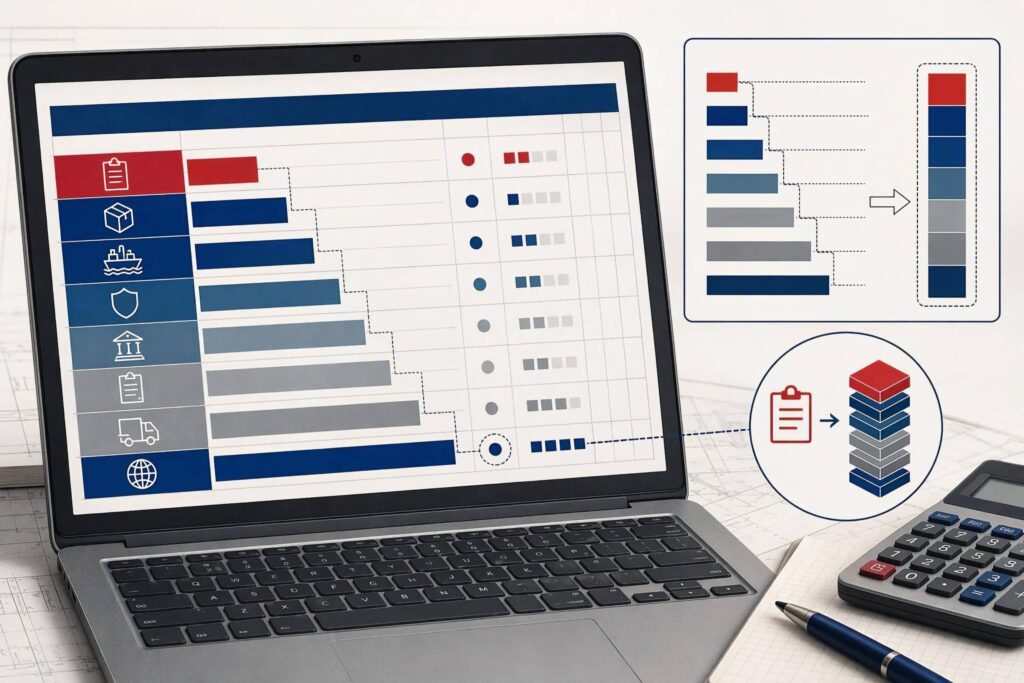
A lower supplier price does not automatically mean a better sourcing opportunity, because the quoted unit price is only the first line of your cost stack. Duty is assessed on the transaction value, the price actually paid or payable for the goods when sold for export to the United States, so the quote is the base for duty rather than the total you will pay (19 CFR 152.103).
The mechanical reason quoted price and landed cost diverge sits in one definition. The customs definition of price actually paid or payable excludes charges for transportation, insurance and related services incident to the international shipment from the country of exportation to the U.S. place of importation (19 CFR 152.102). Freight and insurance therefore sit outside the duty base, which lowers your duty, but they still land on your profit and loss statement, as CBP’s customs value guidance confirms (CBP).
Build the stack yourself, in this order: supplier quoted unit price, international freight, cargo insurance, customs duty, any additional tariffs your HTS subheading carries, brokerage and entry fees, inland drayage, payment and FX fees, and inspection. Divide the total by units received, not units ordered, and compare that number to your domestic landed cost.
Two traps change the arithmetic. Transaction value is not the invoice total you feel: it adds statutory items including packing costs incurred by the buyer, the value of assists such as buyer-supplied tooling, dies, molds and non-U.S. engineering, royalties and license fees tied to the merchandise, and proceeds of later resale accruing to the seller (19 CFR 152.103). If you supply the tooling or pay the supplier’s design house, you have changed your own duty base. And where transaction value cannot be used, valuation falls back through identical or similar merchandise, deductive value, computed value, then the fallback method, as CBP’s customs valuation sequence sets out (CBP).
If the landed cost still clears your target margin after every line, Step 1 passes. If it only clears when you leave lines out, it fails, and no supplier conversation will fix that.
Step 2: Evaluate Your Order Volume and Whether Your Cash Flow Survives the Wait
The right order size is not always the largest order size. Minimum order quantity is a cash-flow and inventory decision before it is a supplier minimum, and the deposit-and-balance structures suppliers usually quote are what determine whether your cash survives the cycle.
That source describes a common first-order shape: 30% deposit at purchase order, 70% before shipment, with variants including 50/50, a 30-30-40 milestone schedule, net-30 or net-60 reserved for established relationships, and 100% upfront for very small or high-risk orders. Treat it as trade convention rather than a published benchmark, because it restates commercial practice rather than measuring it. For a first order with 30 to 60 days of production, ocean transit and net-30 customer terms, the buyer funds the deal for roughly 80 to 135 days before collecting.
SBA working-capital programmes sized for this cycle exist because the gap is normal, not a sign of weakness. The 7(a) Working Capital Pilot carries a maximum loan of $5,000,000, an SBA guaranty of 85% up to $150,000 and 75% above, and maturity up to 60 months, with lenders processing from 1 August 2024; CAPLines covers seasonal, contract, builder and asset-based revolving needs with maximum maturity of 10 years; and the Microloan programme lends up to $50,000 for working capital or inventory (SBA).
Step 3: Evaluate Your Product Category for Regulatory and Tariff Load
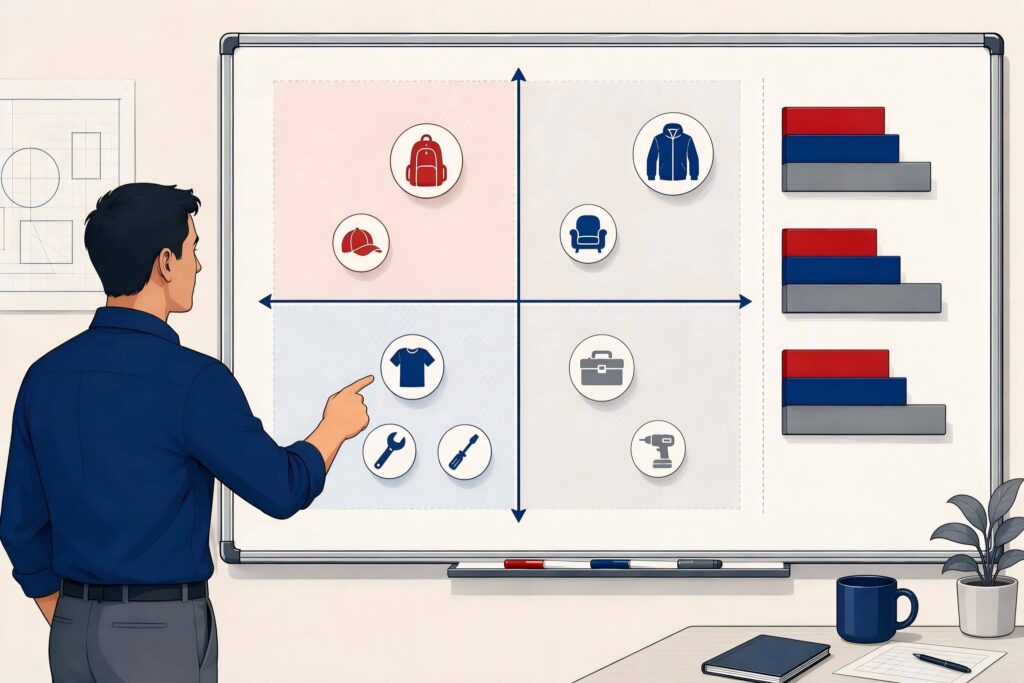
Some categories are strong fits for sourcing products from Asia and others need careful evaluation, and the difference is duty and regulatory load rather than price. Classification is the buyer’s problem, not the supplier’s: CBP advises that classification turns on detailed product characteristics, that your own duty-rate research may not match the eventual rate, and that certainty comes only through a binding ruling (CBP’s guide to how duty rates are determined).
Duty rates sit in three columns. Column 1 General carries normal trade relations rates, Column 1 Special carries conditional and preferential duty-free treatment symbol-coded in the tariff schedule, and Column 2 carries full statutory rates for non-normal-trade-relations origins, with CBP making the final determination of the correct rate rather than the importer (CBP’s importer guide to the three duty-rate columns). Duty-free entry is conditional and the burden is on you: CBP states that it is the importer’s burden to show eligibility for a conditional exemption from duty (CBP).
Labeling adds a second layer that has nothing to do with tariff code. The FTC’s Made in USA Labeling Rule makes it an unfair or deceptive act to label a product Made in the United States unless final assembly or processing occurs in the U.S., all significant processing occurs in the U.S., and all or virtually all ingredients or components are made and sourced in the U.S., with “all or virtually all” meaning no or negligible foreign content (FTC, 86 FR 37022). If your marketing depends on a U.S.-origin claim, an overseas supply chain removes that option.
Strong-fit categories | Categories needing careful evaluation |
|---|---|
Industrial hand tools and lubrication equipment | Apparel and textiles (fiber origin, assembly country, labeling) |
Simple metal and plastic components | Toys and children’s products (safety and testing regimes) |
Replacement parts with stable specifications | Basic electronics (certification and component tracing) |
Private-label goods with no origin claim | Anything marketed on a U.S.-origin claim |
The worked example sits on the strong-fit side. Battery-powered lubrication tools such as the C20 10,000 PSI battery lubrication tool, the C15 18V high-pressure tool and the C200 21V digital automatic lubrication pump are specification-led industrial goods with no consumer-origin claim attached, and OEM/ODM customization is a normal supplier conversation in that category. A U.S.-based sourcing partner such as Costlou is one option for running the classification and labeling questions before an order is placed, not the only one.
Step 4: Assess Your Product Specifications So Supplier Quotes Are Comparable
Vague specifications are not good enough to start, because two suppliers quoting against a vague brief are not quoting the same product. To evaluate Asian suppliers before contacting them, write the specification first: dimensions with tolerances, materials with grades, finish, voltage and pressure ratings where they apply, packaging, labeling, and the test method that proves each one.
Specifications also determine your duty base, which is why they belong in the margin calculation rather than the engineering file. Transaction value under 19 CFR 152.103 adds the value of assists, which the regulation defines to include buyer-supplied materials, components and parts, tools, dies and molds used in production, merchandise consumed in production, and engineering, development, artwork, design work and plans undertaken outside the United States (19 CFR 152.102). A buyer who supplies tooling or pays a foreign design house has increased the dutiable value of every unit that follows.
Where transaction value cannot be used, CBP’s customs valuation sequence falls back through identical or similar merchandise, deductive value, computed value, then the fallback method, and transaction value also fails where the sale is subject to a condition whose value cannot be determined, where there is no bona fide sale for exportation, or where a related-party relationship influenced the price (CBP). A specification that leaves the sale terms ambiguous can push you into that sequence.
Practically, put the same specification document in front of every supplier and require quotes against it, line by line. Quotes that cannot be mapped to your specification lines are not comparable, and the cheapest one is usually the one that answered a different question.
Step 5: Define Your Quality Requirements Before Production, Not After the Container Arrives
Quality is a specification you write before production, not an inspection you schedule after the container arrives. The current AQL sampling standard is ISO 2859-1:2026, which supersedes ISO 2859-1:1999 and specifies an acceptance sampling system of single, double and multiple sampling plans for inspection by attributes, indexed by acceptance quality limit.
AQL is a sampling acceptance rule, not a guarantee of zero defects. Inspection levels under ISO 2859-1 are General I, II and III, with II the default for normal severity, III appropriate for a supplier with recent quality problems, and I described as very risky as a default; Special S-1 to S-4 apply to small samples or destructive tests, and sample size and accept/reject limits come from the standard’s master tables keyed to lot size, inspection level and chosen AQL (the practical breakdown of AQL inspection levels). Choose the level and the AQL deliberately, and write both into the purchase order.
The timing matters more than the method. A defect caught at origin is fixed before the balance payment leaves your account. A defect caught in the U.S. adds return freight, rework or scrap, and a chargeback on goods you have already paid for in full, with no leverage left. That is why the inspection point belongs before shipment, not at your dock.
If your category has no meaningful defect definition, you cannot inspect against it. Write the failure conditions first, then choose the sampling plan that detects them.
Step 6: Assess Your Team's Time and Capability to Run an Overseas Process
Someone on the team has to own the import, and that person carries a legal duty, not just a task list. The importer of record is responsible under Section 484 of the Tariff Act, 19 U.S.C. § 1484, for using reasonable care to enter, classify and determine the value of imported merchandise, and CBP then fixes the final classification and value (CBP’s reasonable care guidance for importers of record, revised September 2017).
That duty is not transferable by delegation to a supplier. CBP’s own guidance notes that informed-compliance publications are not binding and lack the force and effect of law except as authorized or incorporated into a contract, so the responsibility sits with your company regardless of who prepared the paperwork (CBP). Classification, valuation and reasonable care are yours.
Budget the hours honestly for a ten-person company. The recurring work includes supplier correspondence across time zones, specification and revision control, sample approval, inspection coordination, freight booking, customs entry review, duty and fee reconciliation, and defect claims. None of it is continuous, and all of it is deadline-bound, which is the harder problem for a small team.
Decide who owns each of those tasks by name before the first purchase order. If the answer is “someone will handle it,” the process will run until the first exception and then stall, usually at the point where money is already committed.
What a U.S.-Based Sourcing Partner Changes About the Six Answers
A U.S.-based sourcing partner changes the six answers by absorbing the parts of the process that carry legal duty, time-zone lag and specialist knowledge, while leaving the commercial decision with you. The checks themselves do not change; what changes is who performs them and how quickly an exception gets resolved.
The clearest difference is on the duty side. Classification is the buyer’s problem, and CBP makes the final determination of the correct rate rather than the importer, with binding rulings available where certainty is needed (CBP). A partner who works in that system daily can prepare the classification and valuation file that supports your reasonable care position, which is the same duty the importer of record carries under Section 484 of the Tariff Act (CBP).
The second difference is on cash and calendar. A partner who runs the deposit, production and balance-payment sequence against a known transit range can compress the interval between your deposit and your first saleable unit, and can tell you before you commit whether the timeline fits your working capital rather than after .
The third is on quality timing. An inspection point placed before the balance payment is only useful if someone is there to act on the result, and that is a staffing question as much as a sourcing one (the practical breakdown of AQL inspection levels).
What a partner does not change: your margin, your order size, your category’s regulatory load, or your team’s capacity to sell what arrives. Those remain your answers, and a partner who tells you otherwise is selling rather than advising.
FAQ
Isn't sourcing products from Asia only worth it at large volumes?
No. Volume affects unit price, but the binding constraint for most small importers is cash flow, not quantity. A first order commonly runs 30% deposit at purchase order and 70% before shipment, which means the buyer funds the deal for a long stretch before collecting from customers. A smaller order that clears your cash-flow timeline beats a larger one that does not.
The quote I got was cheaper than my domestic price, isn't that the answer?
It is the first line of the answer, not the answer. Duty is assessed on transaction value, the price actually paid or payable, so the quote is the base for duty rather than your total cost (19 CFR 152.103). Add international freight, insurance, duty, brokerage, drayage, payment fees and inspection, then divide by units received. If the landed cost still clears your margin, the quote was a good sign.
How do I know if my product category carries too much regulatory load?
Start with the tariff schedule and the labeling rules. Duty rates sit in three columns, with Column 1 Special carrying conditional duty-free treatment that you must prove eligibility for, and CBP making the final rate determination (CBP’s importer guide). If your marketing relies on a U.S.-origin claim, the FTC’s “all or virtually all” test at 16 CFR Part 323 will not be satisfied by an overseas supply chain (FTC).
What if I already tried sourcing once and it went wrong?
Diagnose which of the six checks failed rather than abandoning the category. The most common structural failures are a landed cost that was never calculated, a specification too vague to compare quotes against, and an inspection point placed after the balance payment instead of before it (the practical breakdown of AQL inspection levels). Each of those is fixable on a second attempt without changing suppliers.
How long does the whole process take from first contact to goods received?
Plan on the transit range plus production and inspection time, not a single number. Ocean freight from China to the U.S. runs 14 to 42 days port-to-port and 19 to 47 days door-to-door for full container loads, with less-than-container loads at 22 to 50 days door-to-door. Add 30 to 60 days of production and the deposit-to-collection cycle commonly reaches 80 to 135 days.
Conclusion
The six checks produce a decision, and the decision is yours to make with your own numbers. Calculate the landed cost before you talk to anyone, test whether your cash survives the wait, weigh your category’s duty and labeling load, write specifications that make quotes comparable, fix quality requirements before production, and name the person who owns the import.
If any check fails, the answer is no for now, and that is a useful answer. It costs far less than a deposit on goods whose quote never becomes a margin.
If all six pass, the next step is not a purchase order. It is a conversation about who runs the process: classification and valuation support, supplier vetting, pre-shipment inspection, and the deposit-to-collection timeline. That is the point at which it makes sense to talk to a sourcing expert and have the checks run against your actual product and volumes before any money moves.